Monitor riser and shelf from one board
A monitor riser should put the top edge of the screen about 1 in. below your seated eye height. Riser height is seated eye height, minus desk height, minus the screen's top edge on its own stand, minus 1 in. At a 29 in. desk that is 1.5 to 6 in. for most adults from 5 ft 8 in. to 6 ft 2 in.
The woodworking is one 8 ft 1x10, three crosscuts, a rip and two dadoes. The number you build to is where risers go wrong, so it comes first.
The height you actually need
The target was set in the earlier note on desk height and monitor position: top of the screen at eye level or up to 2 to 3 in. below it. Aim for the middle of that range, with the top edge about 1 in. under your eyes. Your eyes, measured in your chair, sitting the way you actually sit.
minus desk height
minus top-edge height of the monitor on its own stand
minus 1 in.
top-edge height = height of the panel centre above the desk
plus half the panel height
Example: 5 ft 11 in., 29 in. desk, 27 in. monitor with its top edge
18 in. above the desk. Eye height about 49.5 in.
49.5 minus 29 minus 18 minus 1 = 1.5 in. of riser
Measure the monitor: tape from the desk to the top edge, stand at its lowest. A 16:9 panel sold as 24 in. has a picture about 11.8 in. tall, a 27 in. one about 13.2 in. The table assumes top edges at 16 and 18 in., which is what a fixed stand lifting the bottom bezel about 3.5 in. gives.
| Person | Seated eye height | Desk | Riser, 24 in. monitor | Riser, 27 in. monitor |
|---|---|---|---|---|
| 5 ft 2 in. | 43.5 in. | 25 in. (elbow) | 1.5 in. | none |
| 5 ft 2 in. | 43.5 in. | 29 in. (standard) | none | none |
| 5 ft 5 in. | 45.5 in. | 26 in. (elbow) | 2.5 in. | 0.5 in. |
| 5 ft 5 in. | 45.5 in. | 29 in. (standard) | none | none |
| 5 ft 8 in. | 47.5 in. | 27 in. (elbow) | 3.5 in. | 1.5 in. |
| 5 ft 8 in. | 47.5 in. | 29 in. (standard) | 1.5 in. | none |
| 5 ft 11 in. | 49.5 in. | 28 in. (elbow) | 4.5 in. | 2.5 in. |
| 5 ft 11 in. | 49.5 in. | 29 in. (standard) | 3.5 in. | 1.5 in. |
| 6 ft 2 in. | 52 in. | 29 in. (standard) | 6 in. | 4 in. |
How the estimates were made: median sitting eye height, popliteal height and sitting elbow height from the 2012 US Army anthropometric survey, as summarised by the NC State Ergonomics Center, scaled to stature. Seat set to popliteal height plus 1 in. of shoe. One inch taken off eye height because the survey measures people sitting upright and nobody works that way for long. "Elbow" means a desk set to seated elbow height, as the earlier note recommends. Rounded to the nearest half inch.
Two things the table says that riser product pages do not. First, under about 5 ft 6 in., a standard 29 in. desk already puts a fixed-stand monitor at or above eye level. A riser makes that worse; the fix is a lower desk or a monitor arm. Second, lowering a desk to elbow height is exactly what creates the need for a riser. The two corrections come as a pair, and the riser is the cheap half.
Board choice and span
A 1x10 is 3/4 in. by 9-1/4 in. actual, wide enough for most monitor feet and for a keyboard underneath. If your stand's foot is deeper than about 8-1/2 in., use a 1x12 (11-1/4 in.) and the same cut list.
A 24 to 27 in. monitor with its stand commonly weighs 8 to 15 lb; the spec sheet gives yours. It sits in one spot indefinitely, and wood under a permanent load keeps deflecting. US timber design allows for that with a creep factor of 1.5 on seasoned lumber.
board: 3/4 x 9-1/4 in. eastern white pine
stiffness (E): about 1,240,000 psi
load: 15 lb at mid-span
sag when loaded: about 0.027 in.
sag after long-term creep: about 0.04 in.
target, 0.02 in. per foot: 0.054 in. on this span
load that reaches it, long term: about 20 lb
One monitor on plain pine is fine. Two monitors, or one plus speakers, is not, and that is what the back rail is for. Glued under the rear edge, a 2-1/4 in. rail makes the top an L-section about twelve times stiffer on paper. Less in practice, since the monitor sits in front of the rail, but enough to stop thinking about sag.
Strength is not the question. Clear pine on this span would take something like 900 lb at mid-span before breaking, on paper; a badly placed knot cuts that sharply and it is still far beyond any desk load. Stiffness is the limit.
Poplar runs about 1.6 million psi, a quarter stiffer than white pine, and red oak about 1.8 million, half again as stiff. Leave MDF out: it keeps creeping under a load that never moves, as the note on what actually sags in a desk top explains.
At the store, sight down each edge and reject crook and twist. More than 1/16 in. of cup across the face will show. Plan the cuts so any knot near the middle lands in the offcut, and let the board sit in the room for a few days before cutting.
Cut list from one 1x10
trim the factory end: about 1 in.
A top x1: 36 in.
B legs x2: 3-1/2 in. (riser height minus 1/2 in.)
C back rail x1: 32-1/2 in. long, ripped 2-1/4 in. wide
rail width = riser height minus 1-3/4 in.
kerfs: 4 x 1/8 in.
used: about 77 in.
left over: about 19 in., plus a 32-1/2 x 6-7/8 in. strip from the rip
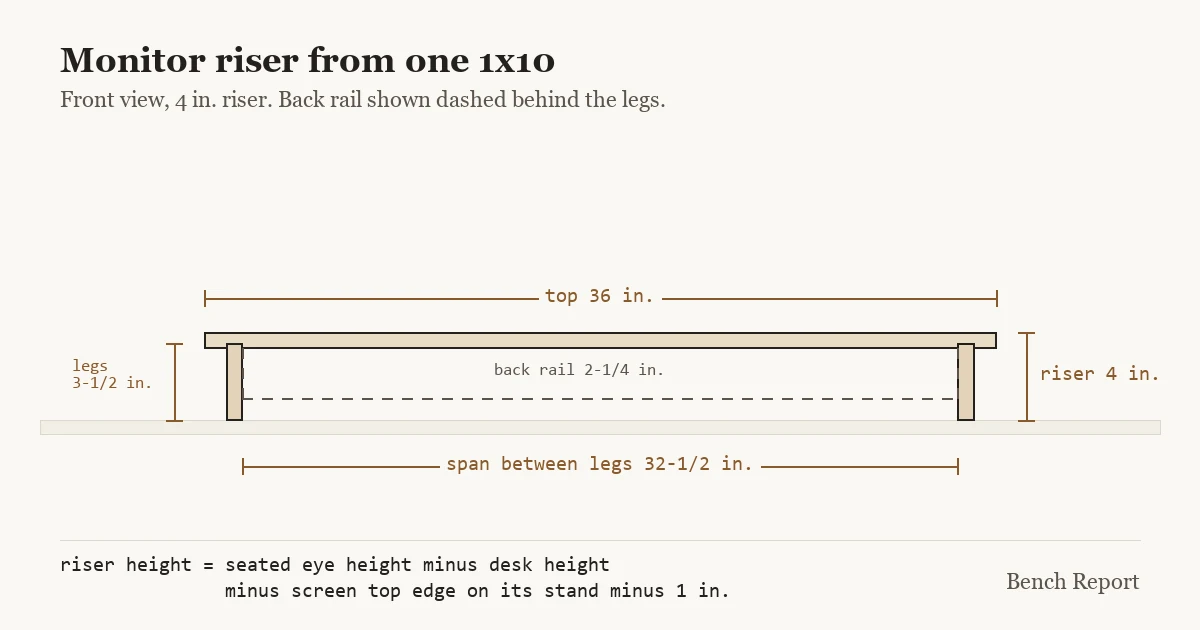
Leg length is riser height, minus the 3/4 in. top, plus the 1/4 in. in the dado. The legs sit 1 in. in from each end, which gives the 32-1/2 in. span. The rail is the exposed leg height less 1 in., leaving a gap for cables.
Under a 4 in. riser there is 3-1/4 in. of clear height and about 8-1/2 in. of depth in front of the rail. That is the shelf: a keyboard pushed out of the way, a notebook, headphones. Measure the keyboard first if parking it there matters.
Below a 2-1/2 in. riser there is no room for a useful rail; leave it out, and a 6 ft board is enough. With the rail, 6 ft comes up about 5 in. short. For two monitors, make the top 48 to 60 in. and add a centre leg instead of a rail. Halving the span cuts sag eightfold, because span is cubed.
Keep the offcuts for testing the dado width and the finish.
Joinery that holds
Weight pressing straight down is handled by any joint. What loosens a riser is the sideways shove when someone grabs it by the end, or knocks it with a keyboard.
- Dado the top. 1/4 in. deep, 1 in. in from each end, cut to the board's real thickness, which is rarely exactly 3/4 in.; test on an offcut. A router against a clamped straightedge or a dado stack both work. The dado squares the leg and takes the racking.
- Screw from below. Two angled screws from the inside face of each leg into the underside of the top, as pocket screws or toe-screws, pull the joint tight. Screws down through the top land in end grain, hold poorly, and leave heads where the monitor stands.
- Glue it. Top and legs come from one board, and their 9-1/4 in. widths run across the grain in the same direction, front to back. They move together, so nothing fights the glue.
- Glue the rail along its length. Long grain to the underside of the top, flush with the back edge, clamped every 6 in. One piloted screw through each leg into the rail end keeps it aligned; the 32-1/2 in. glue line does the stiffening.
Check diagonals before the glue sets. Out of square, it rocks on the desk.
Finishing
Sand to 180 grit and break every edge. A 1/8 in. roundover on the front edge is kinder to wrists if the keyboard ends up in front of it.
Pine blotches under most stains: use a pre-stain conditioner and test on the offcut, or skip the stain. Clear water-based finish keeps pine pale; oil-based turns it amber within a year or two.
Finish every face, underside included. A 9-1/4 in. board sealed on one side takes up moisture unevenly and cups, and a cupped riser rocks. Three thin coats, scuffed at 320 grit between them.
Then wait. Fresh finish is soft, and rubber stand feet can stick to it or print into it. Give it the full cure time on the can before the monitor goes on. Cork or felt pads under the legs protect the desk; subtract their thickness from the leg length, or the riser ends up taller than your number.
Last, sit down and check: top edge about an inch below your eyes, back where it normally rests. Cut the legs 1/4 in. long on purpose and trimming after a week of use costs ten minutes. Cutting new legs costs another board.
Questions
How high should a monitor riser be?
High enough to put the top edge of the screen about 1 in. below your seated eye height. Take your seated eye height and subtract your desk height, the height of the screen's top edge on its own stand, and 1 in. For adults between 5 ft 8 in. and 6 ft 2 in. at a 29 in. desk, that usually comes to 1.5 to 6 in.
What wood for a monitor shelf?
Any flat, dry solid wood. White pine is enough for one monitor on a 32-1/2 in. span. Poplar is about a quarter stiffer and red oak about half again as stiff. Avoid MDF for a load that never moves, because it creeps and keeps sagging.
How much weight can a pine shelf hold?
Its breaking load is in the hundreds of pounds, so the real limit is sag. A 3/4 by 9-1/4 in. white pine top on a 32-1/2 in. span reaches a sag target of 0.02 in. per foot at about 20 lb left at mid-span for the long term. A back rail glued under the rear edge raises that many times over.
Should the top of the monitor be at eye level?
At eye level or up to 2 to 3 in. below it. The relaxed gaze falls slightly below horizontal, so a screen centred on the eyes sits a little high. Aiming the top edge about 1 in. below eye level lands in the middle of that range.
Do I need a riser if my monitor stand adjusts in height?
Usually not. Raise the stand first and measure again. A riser is for fixed stands, for a stand that tops out too low, or for when you want the shelf underneath for a keyboard or notebooks.
Sources
- Body dimensions: Gordon, C. C. et al. (2014), 2012 Anthropometric Survey of U.S. Army Personnel, summary tables published by the NC State Ergonomics Center (11/2024 edition), read 13 November 2026.
- Stiffness and strength of clear wood at 12% moisture: USDA Forest Products Laboratory, Wood Handbook, FPL-GTR-282 (2021), chapter 5.
- Sag target of 0.02 in. per foot: Woodbin, The Sagulator and its shelf sag tables.
- Long-term creep factor of 1.5 for seasoned lumber: American Wood Council, National Design Specification for Wood Construction.